
Big Walk Beginner Guide
How to set up the group, pick a world size, get everyone into the same session, and understand what the host owns before your first trip across the island.
Quick answer
Gather at least two people who can play together more than once, and pick a host who will come back — the host keeps the only save. When they open a session they choose a 2, 3, or 4-plus player world, and that choice changes the puzzles you meet. Everyone else joins from a platform friends list or a short Join Code. All talking happens inside the game: the official FAQ states that talking to players outside the game is not allowed.
- Players
- 2–12 online
- World size
- Host picks per session
- Save file
- Host only
- Outside voice chat
- Not allowed
Agree on four things before you open the game
There is no random matchmaking in Big Walk. House House built it for one steady group playing across several sessions, so deciding who is actually in is the first move, not admin overhead.
Everyone needs their own device and their own copy. A session puts every player in the world at the same time, so a single shared-library copy will not cover two people at once.
- Who hosts. The host keeps the save, so pick whoever is most likely to be free next week.
- How many people will finish the session, not just start it. That number decides the world size.
- Whether the group wants puzzle hints at all, and who is allowed to look them up.
- Headphones. Proximity voice is the whole design, and speakers leak into other players' microphones.
Pick the right world size: 2, 3, or 4+
Every time the host opens a session they choose a 2-player, 3-player, or 4-plus version of the world. That choice changes which puzzles the group meets, so it is worth a moment rather than a reflex.
The number is a floor, not a ceiling. The official FAQ frames it as a minimum, which has a practical consequence: if two of your five people have to drop out after an hour, the host should open the smaller world rather than the one matching tonight's headcount.
Group size changes the feel more than the difficulty. A pair gets a focused, quiet puzzle game. A full twelve turns into cheerful chaos where half the challenge is getting anyone to listen.
Getting everyone into the same session
Add each other on Steam, PlayStation, or Nintendo first. Once you are friends on the platform, sessions your friends host show up on their own.
The host can also share the short Join Code generated for the session. That is the route for anyone who is not on your platform friends list, and it is what cross-platform groups use.
The Mac App Store build is the exception worth knowing in advance: it has no Game Center support, so those players always join by Join Code. It saves someone ten minutes of hunting for a friends list that is not there.
What the host actually owns
The host is the keeper of the save. Progress records automatically on their side, and everyone else is a guest inside that world.
When the host ends the session, every other player is disconnected. That is designed behaviour, not a crash or a bad connection.
Continuing next week means the same person hosting again. A different host opens a different save, and your original world is still sitting where you left it, on the first host's account.
The host also has moderation controls under Session Details if someone needs to be removed part-way through.
The rule that makes the game work
Big Walk expects every conversation to happen inside the game, through proximity voice or in-game text chat. The official FAQ is blunt about it: talking to players outside the game is not allowed.
That is not fussiness. Distance, walls, soundproof rooms, and equipment that stops working are the puzzles. A Discord call running in the background deletes most of them.
Text chat is a first-class option, not a fallback. House House confirms the whole game can be played that way without missing content, which matters for anyone without a working microphone or who would rather not speak.
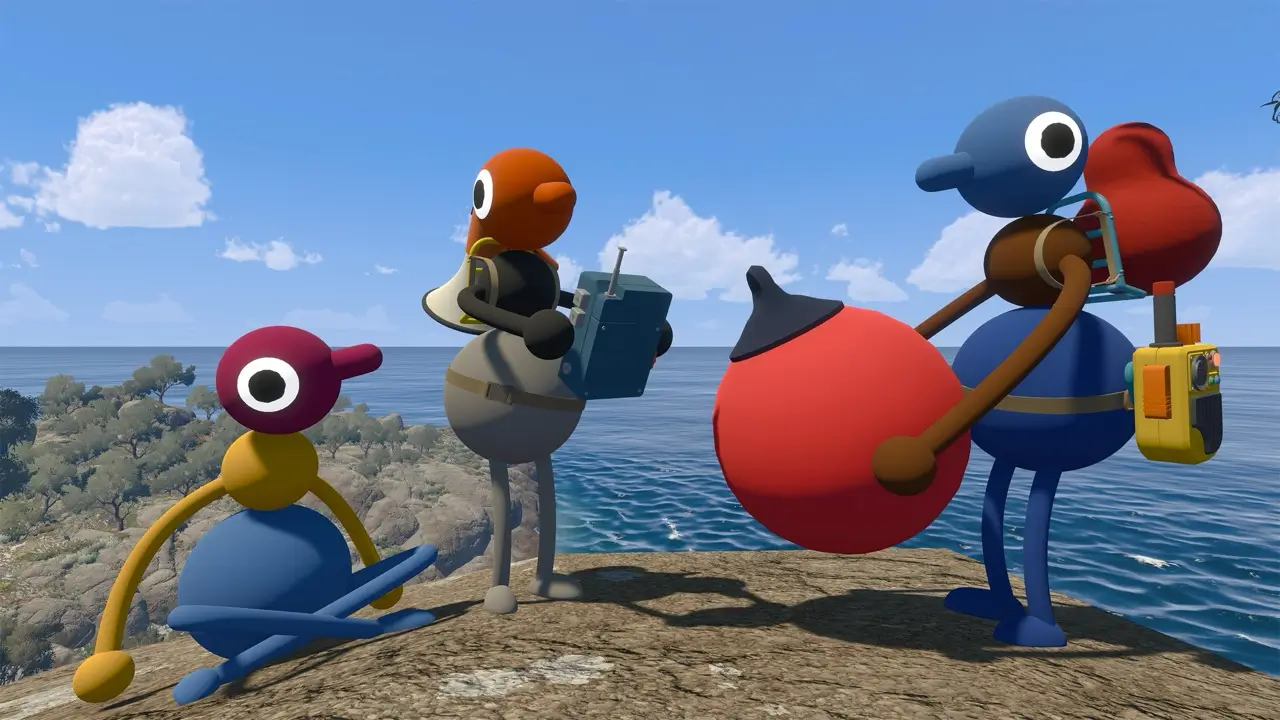
- Walkie-talkies for talking across distance
- Megaphones for being heard by a crowd
- Binoculars for seeing what you cannot reach
- Laser pointers for indicating exactly which one you mean
- Pointing and waving for when you have no words at all
What a good first session looks like
Describe before you guess. Shape, colour, position, order, and sound all survive a trip down a radio. A conclusion does not.
Split roles instead of crowding. One person watches, one person operates, and everyone else stays quiet until they are asked.
When the game separates you, resist walking straight back to each other. Being apart is usually the point of the puzzle.
Plan a series rather than a marathon. Player reports put a full playthrough somewhere around 9 to 20 hours depending on group size and how much you explore, which is several evenings.
Will it run on your machine?
On PC, Steam lists Windows 10 with an i7-7700K or Ryzen 5 1600X, 12 GB of RAM, and a GTX 750 Ti as the minimum, and Windows 11 with an i5-10600K or Ryzen 7 3700X, 16 GB, and a GTX 1070 as recommended.
The Mac build needs macOS 15 or newer and is sold both on Steam and on the Mac App Store.
Console players need a PS5 or a Switch 2. There is no original Switch version, and online play on PS5 follows PlayStation's usual subscription rules.
The store page is the only place these numbers stay current. Check it before buying for a machine you are unsure about.
Frequently asked
Can someone join a trip that is already running?
Yes. Group size can change during a session and the host can let new people in. The world size chosen at the start still shapes the puzzles, so a world opened for two does not become a twelve-player world just because ten people arrive.
Can we just use Discord instead of in-game voice?
No. The official FAQ says talking to players outside the game is not allowed. It works technically, but it removes the mechanic the entire game is built on.
Can we play without microphones?
Yes. In-game text chat covers the whole game, and House House confirms nothing is missed by playing that way. It is a supported way to play, not a downgrade.
What happens when the host quits?
Everyone else is disconnected and the session ends. The save stays with the host, so the group carries on whenever that person hosts again.
Does every player need to buy the game?
Plan on one copy per player. Everyone is in the world at the same time, so a single shared-library copy will not cover a group. Check the current family-sharing rules on your platform before counting on anything else.
Can the host remove a player mid-session?
Yes. Moderation settings sit under Session Details while a session is running.
How many evenings should we set aside?
Player reports cluster around 9 to 20 hours for a full playthrough. Group size, how thoroughly you explore, and whether you chase all 12 achievements move that figure a lot, so treat it as a range rather than a target.
Sources and verification
Official pages are the primary reference. Player reports are labelled as community samples and never presented as official facts.