
How many players can play Big Walk? 2 to 12, and no solo mode
Big Walk takes 2 to 12 players. There is no single-player mode, no split screen and no Remote Play Together — Steam's own category list confirms all three. Here is what the numbers actually mean for your group.
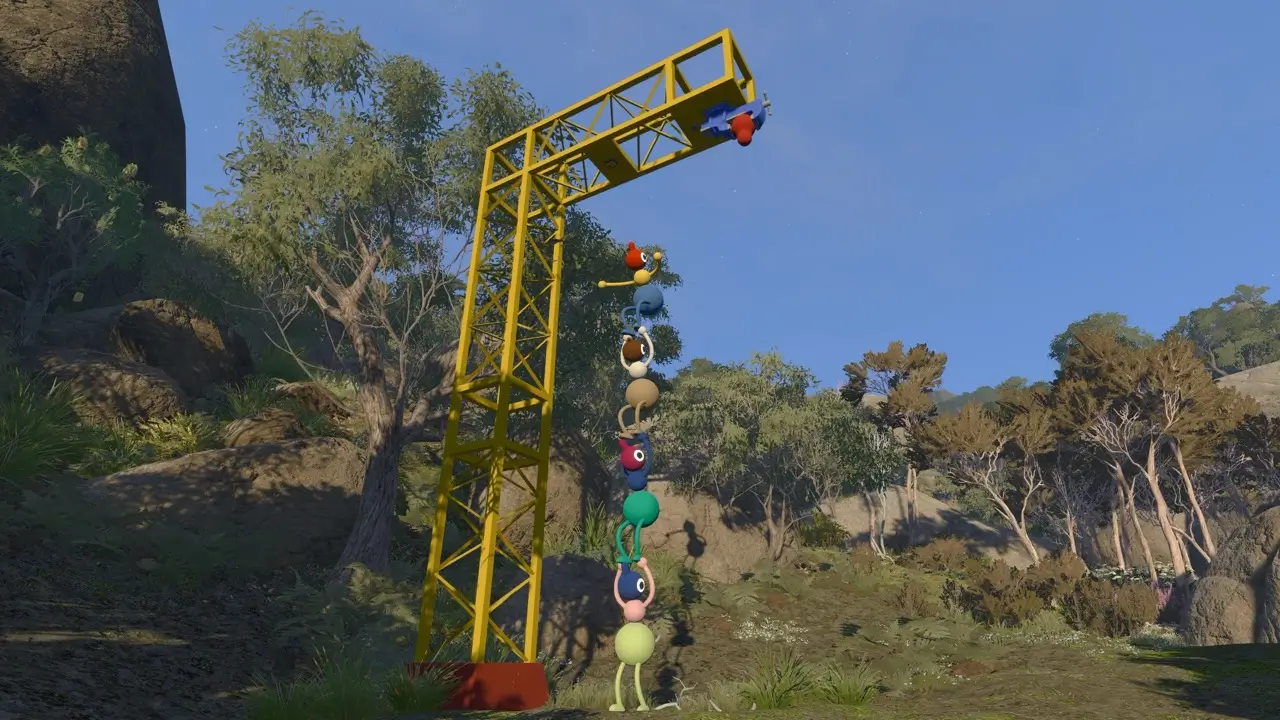
Quick answer
Two minimum, twelve maximum. There is no single-player mode and no couch co-op: Steam's category list has no Single-player, no Shared/Split Screen and no Remote Play Together entry, only Online Co-op and Cross-Platform Multiplayer. So everyone needs their own screen and their own copy, though Family Sharing works. When the host starts a trip they choose a world built for 2, 3, or 4-plus players, and that choice changes which puzzles the island presents — it is not a difficulty slider.
- Minimum
- 2 players
- Maximum
- 12 players
- Solo mode
- None
- Split screen
- None
On this page
- Two at the bottom, twelve at the top
- You cannot play Big Walk alone
- No split screen, no couch co-op, no Remote Play Together
- The 2 / 3 / 4-plus choice is not a difficulty setting
- How many should you actually play with?
- What actually changes as you add people
- Getting everyone in
- Frequently asked
- Sources and verification
Two at the bottom, twelve at the top
The floor is the number that surprises people. Big Walk does not have a single-player mode, and this is not a case of solo being possible but unpleasant — the game will not start a trip for one. Nearly every puzzle is built around two people doing different things in different places at the same time, so there is nothing for a solo player to do.
The ceiling is twelve in one session. That is a lot for a game with no matchmaking, and in practice very few groups run at the top of the range.
Between those two numbers the game does not simply scale. The host chooses a world sized for 2, 3, or 4-plus players when the trip starts, which is a real branch rather than a difficulty setting.
- 2 — minimum, and the most common way the game is played
- 3 — its own world layout, distinct from both neighbours
- 4+ — one shared configuration for four and above
- 12 — the hard ceiling for a single session
You cannot play Big Walk alone
This is the single most searched thing about the game after crossplay, and the answer does not have caveats. Steam lists the game's categories as Multi-player, Co-op, Online Co-op and Cross-Platform Multiplayer. There is no Single-player category, which is the store's own machine-readable way of saying the mode does not exist.
It is worth understanding why, because it explains the rest of the design. Voice in Big Walk falls off with distance, and puzzles routinely require one person to be somewhere they cannot see the other. The game is about the gap between two people, so removing the second person removes the game.
If you have nobody to play with, the honest answer is to find someone before buying rather than to buy and hope. There is no matchmaking to fall back on.
No split screen, no couch co-op, no Remote Play Together
Three separate things people mean by 'can we play on one console', and all three are no.
There is no Shared/Split Screen category on the store page, so two players on one machine is not supported. There is no Remote Play Together category either, which rules out the usual workaround of streaming a local session to a friend. And because the game has no local multiplayer at all, there is no couch mode to fall back on.
Everyone needs their own device and their own screen. On Steam, Family Sharing is supported, so a household may not need to buy the game twice — but the two people still cannot play at the same time on shared library terms, so for simultaneous play you are buying copies.
- Split screen — not supported
- Couch co-op on one console — not supported
- Remote Play Together — not supported
- Online co-op — supported, and the only way to play
- Family Sharing — supported on Steam, with the usual simultaneous-use limits
The 2 / 3 / 4-plus choice is not a difficulty setting
When the host starts a trip they pick which version of the world to load. It is easy to read this as small, medium and large, but it changes the content rather than the challenge.
A puzzle that needs two people on two pressure points cannot exist in a world designed for one pair the same way it does with five people spare. So the 3-player world is not the 2-player world plus a third body — it is a different arrangement of the island.
Two consequences worth planning around. First, if your group size is unstable, pick the world for the number of people who will reliably show up, not the number who said yes. Second, a second run at a different size is closer to new content than a replay, which is the game's real answer to 'is it replayable'.
How many should you actually play with?
Supported is not the same as advisable. Twelve is possible; twelve is rarely good.
Proximity voice is the reason. Because you only hear people near you, a spread-out group of eight is not one conversation — it is three or four separate ones that keep merging and splitting. That is delightful for an hour and exhausting for an evening, and it makes coordinating a two-person puzzle harder, not easier.
Most groups settle at two or three. Two is the tightest experience and the easiest to schedule. Four and up is a party game, which is a legitimate thing to want, but expect to spend more of the session finding each other than solving anything.
- 2 — cleanest puzzles, easiest to schedule, hardest to abandon
- 3 — one spare person to scout while a pair works a puzzle
- 4-6 — social first, puzzles second; expect slower progress
- 7-12 — a party. Fun, chaotic, and not the way to reach the ending
What actually changes as you add people
The number in the lobby is not the interesting part. What changes is how much of the evening goes into coordination rather than into the island.
With two, coordination is free — you are either together or you are deliberately apart, and the second case is usually the puzzle. With four, someone is always slightly out of position, and because proximity voice cuts out at distance, the group cannot simply announce things to everyone. Information has to be carried, relayed by radio, or shouted from a hill.
That is genuinely fun, and it is also the reason a six-person session covers less ground than a two-person one. If your goal is the ending, keep it small. If your goal is an evening with friends, the coordination overhead is the entertainment rather than a cost.
- Two — no coordination overhead; separation is the puzzle, not a problem
- Three — one floater, which helps scouting and complicates timing puzzles
- Four to six — expect a standing rule about where to regroup, or you will lose people
- Seven plus — treat it as a social event; the puzzles become a backdrop
Getting everyone in
There is no matchmaking and no server browser. One person hosts, and everyone else joins with the Join Code the host shares — that code is a room code for a session, not a redeemable key.
The host also holds the save. This is the practical constraint that decides whether a group finishes: the trip continues when the host is available, and not otherwise. Groups that pick a host with a stable schedule get much further than groups that pick whoever bought it first.
Platform does not restrict who can join. Steam, PS5 and Switch 2 players share the same session.
Frequently asked
How many people can be in one Big Walk server?
Twelve in a single session. There is no dedicated server browser — one player hosts and the rest join with that host's Join Code.
Can 4 players play Big Walk?
Yes. Four falls into the 4-plus world configuration, which is one shared layout for four players and above rather than a separate world per number.
How many players can play Big Walk?
Between 2 and 12 in one session. Two is the minimum and the most common; twelve is the hard ceiling.
What is the max players in Big Walk?
Twelve players in a single session.
Can you play Big Walk solo?
No. There is no single-player mode — Steam's category list has no Single-player entry, and almost every puzzle needs two people in two places at once.
Does Big Walk have local co-op or split screen?
No. The store page lists no Shared/Split Screen and no Remote Play Together category. Everyone needs their own device and screen; the only mode is online co-op.
Does everyone need to buy Big Walk?
Everyone needs access to a copy. On Steam, Family Sharing is supported, but simultaneous play still requires separate copies under the usual sharing rules.
What is the best number of players for Big Walk?
Two or three. Proximity voice means larger groups split into several parallel conversations, which is fun socially but slows puzzles down considerably.
Does the player count change the game?
Yes. The host picks a world built for 2, 3, or 4-plus players at the start, and those worlds contain different puzzles. It is a content branch, not a difficulty setting.
Can people on different platforms play together?
Yes. Steam, PS5 and Switch 2 players can share one session through the host's Join Code.
Sources and verification
Official pages are the primary reference. Player reports are labelled as community samples and never presented as official facts.